Direct bookings first
The right system should separate guests you already earned from guests a marketplace truly introduced.
Compare restaurant reservation systems for direct bookings, marketplace reach, guest data, payments, Google visibility, and branded booking control.
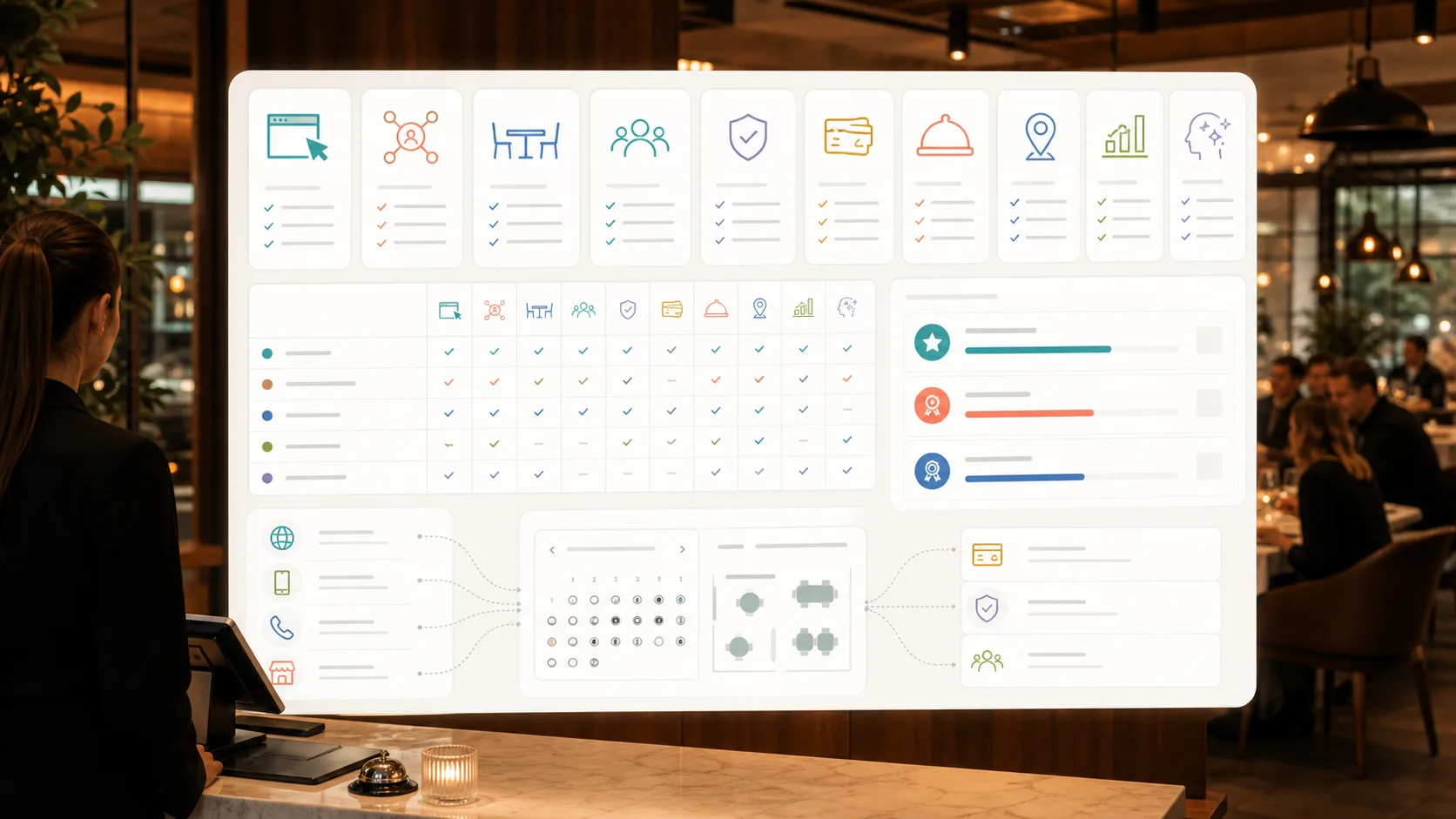
The best restaurant reservation system is the one whose business model matches how guests actually find and book the venue. If guests already search for the restaurant directly, prioritize branded booking control, live availability, owned guest data, flexible payment rules, Google visibility, and no per-booking commission on standard direct reservation intake.
The right system should separate guests you already earned from guests a marketplace truly introduced.
Tables, shifts, areas, pacing, payment state, and booking rules need to stay aligned across channels.
Deposits, card holds, prepayment, gift cards, and experiences should support the booking rather than fragment it.
The best restaurant reservation system depends less on feature count and more on strategy.
If a restaurant needs new diner discovery, a marketplace-led platform can help. If the team wants a large guest CRM and marketing automation suite, an enterprise hospitality platform may be the right fit. If the venue sells ticketed events, prepaid menus, tastings, or pop-ups, an experience-led system may be strongest.
But if guests already search for the restaurant by name, tap the Google Business Profile, visit the website, follow an Instagram link, scan a QR code, or return after a previous visit, the restaurant has a direct-demand problem. It needs to convert guests it already earned without losing brand control, guest context, payment rules, or margin.
That is the lens for this guide: the best restaurant reservation systems for direct booking control.
Direct booking control is not just having a booking widget on the restaurant website. A widget can still route demand into a generic flow, split guest data from operations, hide payment context, or make the restaurant dependent on a marketplace profile.
A restaurant has real direct booking control when the booking journey keeps six things together:
That is why a simple "top tools" list is not enough. Restaurants should choose based on the kind of demand they want to build.
This is not a universal ranking. A small chef-led restaurant, a hotel group, a neighborhood bistro, a high-volume casual group, and a Michelin-level tasting-menu venue may all need different systems.
Use this shortlist as a strategy map.
| System | Best for | Main strength | Watch-out |
|---|---|---|---|
| Reslify | Direct booking control, branded booking pages, Google visibility, AI-guided booking, payment rules, add-ons, and gift cards. | Focused direct booking platform with no per-booking commission on standard direct reservation intake. | Not a consumer marketplace; restaurants looking mainly for rented diner discovery may still want marketplace exposure elsewhere. |
| OpenTable | Marketplace discovery and mature reservation operations. | Large diner network, restaurant plans, table management, experiences, guest profiles, reviews, reporting, and marketing tools. | Plan and cover-fee economics need careful review, especially when separating marketplace demand from direct-intent bookings. |
| SevenRooms | Enterprise guest experience, CRM, marketing automation, table management, and multi-location operations. | Broad hospitality suite with reservations, guest profiles, automated marketing, channel distribution, events, add-ons, Voice AI, API, and integrations. | Can be more platform than a restaurant needs if the main job is focused direct booking ownership. |
| Tock | Prepaid experiences, events, tasting rooms, ticketed hospitality, and no-show protection. | Reservations, experiences, events, waitlists, deposits, credit card holds, prepayment, guest data, and no cover fees. | Best fit when experiences and paid inventory are central, not just when the restaurant needs a simple branded direct booking layer. |
| Resy | Premium restaurant discovery, Amex-connected demand, and hospitality-focused operations. | Reservations, guest management, operational tools, performance insights, experiences, events, demand programs, and Amex partnership. | Less transparent public pricing; restaurants should confirm package scope and how direct channels are handled. |
| Eat App | Reservation and table management with CRM, waitlist, WhatsApp, marketing, and published self-serve pricing. | Public plans, online bookings, waitlist, widgets, guestbook, marketing, WhatsApp, analytics, and integrations depending on tier. | Plan limits and add-ons matter; the best tier depends on cover volume, messaging needs, and integrations. |
| TableCheck | International restaurants, hotels, and groups that need branded booking, guest profiles, operations, and multilingual reach. | Branded booking journey, multi-channel consolidation, table operations, direct guest relationships, analytics, surveys, and 23 languages. | Demo-based evaluation; restaurants should confirm regional fit, pricing, and payment/channel details. |
| ResDiary | Commission-free booking operations for restaurants, hotels, bars, groups, and cafes in supported regions. | Reservation and table management, online bookings, Reserve with Google, social channels, Dish Cult, vouchers, event manager, integrations, and add-ons. | Add-on pricing and payment/gift voucher surcharges need review before comparing total cost. |
| TheFork Manager | European marketplace visibility plus restaurant management. | European diner platform, table reservations, multi-channel booking, marketing, guest data, analytics, and restaurant group support. | Strong marketplace/discovery orientation; direct-brand-first restaurants should separate true incremental diners from owned demand. |
Most reservation-system comparisons start with feature lists: table management, waitlist, reminders, guest profiles, reporting, integrations, and payments.
Those matter. But the first question should be simpler:
That distinction changes the buying decision.
Marketplace demand is when a guest is undecided. They open a marketplace, browse restaurants by date, time, cuisine, neighborhood, or availability, then choose a venue. If that guest would not have found the restaurant otherwise, the marketplace created value.
Direct demand is when the guest already knows the restaurant. They search the venue by name, open the website, tap from Google, click Instagram, scan a menu QR, follow an email link, or return after a prior visit. In that case, the restaurant already created the demand.
Restaurants usually need some mix of both. The mistake is treating them as identical.
For direct-intent guests, the booking flow should feel like the restaurant. It should use the restaurant's brand, explain the right experience, show live availability, apply the correct payment or cancellation rule, and preserve the guest context for service. If a platform mostly moves those guests into its own ecosystem, the restaurant may be giving up control over demand it already earned.
Before choosing any restaurant reservation system, evaluate it across these categories.
The system with the longest feature list is not automatically the best. The best one is the platform whose operating model matches the restaurant's growth model.
Reslify is the best fit for restaurants that want the booking journey to be owned, branded, and commercially useful from the first click.
It is built for teams that already generate high-intent demand through their brand, Google profile, website, Instagram, local reputation, email list, hotel referrals, or repeat guests. Instead of sending those guests through a generic booking flow, Reslify helps the restaurant convert them in a white-label journey that keeps availability, payment rules, add-ons, gift cards, guest context, and operations together.
Reslify is strongest when the restaurant cares about:
The economic model matters too. Reslify uses a flat subscription for the core platform and does not charge per-booking commission on standard direct reservation intake. When money moves through checkout flows such as deposits, prepayments, gift cards, or other paid transactions, app fees are included.
Current landing-supported pricing is region-based: US $79/month or $790/year, Australia A$109/month or A$1,090/year, Europe €69/month or €690/year, and Turkey TRY 3,490/month or TRY 34,900/year.
Reslify is not the best choice if the main goal is to rent demand from a large consumer marketplace. It is strongest when the restaurant wants to own the booking relationship it already worked to create.
OpenTable is one of the most mature restaurant reservation platforms and a serious option for restaurants that want marketplace discovery. Its restaurant pages position the platform around a global diner network, reservation management, table management, guest profiles, marketing, reviews, experiences, private dining, reporting, integrations, and support.
OpenTable is strongest when the restaurant wants:
The tradeoff is economics and ownership. OpenTable's official US pricing page lists Basic, Core, and Pro plans. It also lists per-network-cover fees on Core and Pro, website reservation treatment by plan, and a 2% service fee for prepaid experiences and prepaid ticketing.
For some restaurants, that is fair because marketplace exposure is valuable. For restaurants with strong direct demand, the key question is different: how many bookings are truly incremental, and how many guests already intended to book the restaurant?
That is why OpenTable should be evaluated as a marketplace-led growth tool, not just a reservation book. Read the detailed OpenTable alternative comparison if the main decision is direct booking ownership versus marketplace reach.
SevenRooms is broader than a reservation tool. Its public pages position it as a guest-experience and operations platform with reservations and waitlists, CRM and guest profiles, marketing automation, table management, revenue management, reputation management, events, add-ons, integrations, Voice AI, and partner-channel distribution.
SevenRooms is a strong fit when the restaurant or group wants:
SevenRooms makes sense when the restaurant wants one large hospitality system to connect guest data, marketing, operations, revenue, and channels.
The caution is scope. A restaurant that mainly wants branded direct booking, Google conversion, AI guidance inside booking, payment rules, and owned guest context may not need the whole SevenRooms suite. The platform can be a strong choice, but the buyer should confirm which features are included, which are add-ons, how quote-based pricing works, and whether the operational breadth is worth the implementation effort.
Read the detailed SevenRooms alternative comparison if the decision is between a broad guest-experience suite and a more focused direct booking platform.
Tock is especially strong for restaurants and hospitality businesses that sell more than standard reservations.
Its official pages position the platform around reservations, experiences, events, takeout, waitlists, table and service management, guest data and reports, integrations, discovery, and support. Tock also emphasizes one flat rate, no cover fees, guest data ownership, deposits, credit card holds, prepayment, cancellation policies, and a polished guest experience.
Tock is a strong fit when the restaurant sells:
For restaurants whose identity is built around experiences, Tock belongs on the shortlist.
For restaurants that mainly want a direct booking layer across website, Google, Instagram, staff operations, add-ons, gift cards, and AI booking guidance, the comparison is more nuanced. Tock can handle sophisticated paid hospitality, but the restaurant should still ask whether it needs an experience-first system or a direct-booking-control system.
Resy is a strong candidate for restaurants that care about premium diner demand, hospitality-focused operations, and the American Express ecosystem.
Resy's official restaurant page describes the platform as an end-to-end operating system, guest experience platform, and management software for hospitality businesses. It brings together reservations, guest management, operational tools, and performance insights. The same page highlights experiences and events, demand programs, personalized hospitality, guest data and reporting, discovery through high-value Amex Card Members and marketing, safeguards, partner discounts, restaurants, wineries, hotels, and hospitality groups.
Resy is a good fit when the restaurant wants:
The main due diligence point is pricing and channel treatment. Resy does not present a simple self-serve public pricing grid on the page reviewed for this guide. Restaurants should confirm plan scope, implementation costs, contract terms, payment rules, experience/event fees, and how direct website or Google-originated demand is handled.
Eat App is worth evaluating for restaurants that want a reservation and table management platform with public pricing, guestbook/CRM tools, waitlist, widgets, messaging, marketing, and integrations.
Its pricing page shows a free tier and paid plans, with details such as cover limits, chat inbox, WhatsApp conversations, waitlist management, customizable widget, marketing suites, loyalty, POS and payment integrations, and dedicated success manager depending on plan.
Eat App can be a fit when the restaurant wants:
The evaluation detail is plan fit. Operators should check monthly cover limits, messaging limits, integrations, widget controls, WhatsApp usage, marketing features, payment integrations, and which tier includes the workflows they actually need.
Eat App may work well for restaurants that want a broader operations and CRM layer without immediately moving into a large marketplace model. For direct booking control, compare its branding, Google, payment, and guest-journey flexibility against more focused direct platforms.
TableCheck positions itself as a restaurant booking and guest experience platform. Its official page highlights branded booking journeys, multi-channel booking consolidation, table management, direct guest relationships, guest profiles, preferences, analytics, surveys, and 23 languages.
TableCheck is a strong candidate for:
The due diligence is commercial and regional. Restaurants should confirm pricing, implementation, supported markets, payment rules, Google and social-channel details, integrations, and how guest data is handled across a group.
TableCheck can be a strong fit for global hospitality operations. A smaller restaurant that mainly wants direct booking ownership and fast setup may prefer a more focused platform.
ResDiary positions itself as hospitality venue reservation and table management software. Its pricing page emphasizes zero commission and low monthly fees, and its FAQ says ResDiary offers commission-free bookings from the restaurant website, social media channels, Reserve with Google, and Dish Cult.
ResDiary also offers add-ons such as Order & Pay, Gift Vouchers, phone booking support, Event Manager, SMS, group bookings, POS integration, PMS integration, and CRM/marketing integrations, with listed monthly prices and payment/gift-voucher surcharges.
ResDiary is a strong fit when the restaurant wants:
The watch-out is total cost. Add-ons and processing surcharges can matter, especially if the restaurant needs vouchers, deposits, events, payments, SMS, group booking, or integrations. Compare the full stack, not only the base reservation fee.
TheFork Manager is strongest for restaurants that want European diner exposure and restaurant management tools in one system.
Its official page describes TheFork Manager as restaurant management software that helps restaurants receive bookings from a large European diner platform. It highlights table reservations, multi-channel booking integration, marketing, customer loyalty tools, guest data, performance insights, restaurant groups, MICHELIN restaurants, and integrations with Google, Tripadvisor, MICHELIN, Meta, and more.
TheFork Manager can be a good fit for:
The direct-booking question is the same as with any marketplace-oriented platform: does the platform bring incremental guests, or is it processing guests who would have booked directly? If the goal is direct booking control, restaurants should evaluate how much of their demand should flow through TheFork versus their own website, Google profile, and branded booking journey.
This is the most important strategic split.
| Question | Marketplace-led platform | Direct-booking-control platform |
|---|---|---|
| What is the platform best at? | Helping undecided diners discover and book restaurants across a network. | Helping guests who already intend to book the restaurant complete the reservation in a branded flow. |
| Who owns the guest relationship? | The platform often owns a large part of the consumer identity, browsing experience, profile, reviews, and repeat app behavior. | The restaurant owns more of the booking surface, guest context, brand presentation, and post-booking relationship. |
| When does the model work well? | When the restaurant genuinely needs incremental demand and the marketplace sends guests who would not have booked otherwise. | When the restaurant already gets demand from Google, website, Instagram, reputation, repeat guests, and local intent. |
| What should the restaurant measure? | Incremental covers, cost per seated guest, repeat visits, spend, no-show rate, and source quality. | Direct conversion, booking source, payment commitment, add-on revenue, gift-card redemption, no-shows, cancellation fees, and repeat guests. |
| What is the risk? | Paying for guests the restaurant may already have earned, or training guests to return through the marketplace. | Needing to build demand through owned channels instead of relying on a marketplace app to create discovery. |
Many restaurants should use both modes carefully. A marketplace can be useful for incremental exposure, while a direct system should convert guests who already searched for the restaurant.
The unhealthy version is when all demand is treated like marketplace demand. That can make the restaurant dependent on platforms that bring their own customers to the platform, even when the guest's original intent was to book a specific restaurant.
Reservation software pricing can be hard to compare because platforms use different models.
Some charge subscriptions. Some charge cover fees. Some charge marketplace fees. Some have transaction fees for prepaid experiences, ticketing, deposits, or gift cards. Some use quote-based plans. Some publish base pricing but charge for add-ons, integrations, messaging, SMS, gift vouchers, events, or payment processing.
Use this checklist before signing:
Do not compare only the lowest monthly price. Compare total cost by source and workflow. A $0 or low-cost tool can become expensive if it fragments the booking journey, loses direct guests, or forces staff into manual work. A larger platform can be worth it if it brings measurable incremental demand or replaces several systems the restaurant truly uses.
If direct demand is the priority, these are the features that should shape the shortlist.
| Capability | Why it matters |
|---|---|
| White-label booking pages and widgets | Guests should feel they are booking the restaurant, not being handed off to a generic profile. |
| Reserve with Google and channel alignment | Google demand should use the same availability, rules, and operational context as website bookings. |
| Live availability and table logic | The system must understand shifts, areas, duration, party size, pacing, request-only inventory, and special services. |
| Flexible payment rules | Different bookings need different levels of commitment: free booking, deposit, prepay, optional prepay, or card hold. |
| No-show and cancellation protection | Policies should protect high-risk bookings without making every guest feel punished. |
| Add-ons, experiences, and gift cards | The booking journey should capture revenue moments without sending the guest into separate checkout tools. |
| Guest source and CRM context | Staff should know where the guest came from, what they booked, what they paid or committed to, and what matters for service. |
| AI-guided booking | AI should answer booking-related questions and suggest relevant options while final availability and confirmation stay deterministic. |
| Multilingual support | Restaurants serving local and travel demand need the booking flow to match the guest's language. |
These capabilities turn reservations from simple table intake into a direct revenue and guest-experience system.
Changing reservation systems touches the website, Google, staff workflow, guest communication, reporting, payment policies, and live service. Treat the switch like an operations project, not a quick widget swap.
Use this order:
The goal is not just to move reservations. The goal is to make the restaurant's booking system easier to trust.
Use the full restaurant reservation system migration checklist to assign owners, protect existing bookings and payments, plan channel cutover, train staff, and validate the first live services.
Choose based on the job the restaurant needs done.
| Restaurant priority | Best-fit shortlist |
|---|---|
| We want direct booking ownership from website, Google, Instagram, and repeat guests. | Reslify, TableCheck, ResDiary, Eat App |
| We want no per-booking commission on standard direct reservation intake. | Reslify, Tock, ResDiary, then confirm exact source rules for other platforms |
| We want the largest marketplace-style diner discovery in the US. | OpenTable |
| We want a broad enterprise CRM, marketing automation, and guest-experience suite. | SevenRooms, Resy, TableCheck |
| We sell prepaid menus, ticketed events, tastings, or experience-led hospitality. | Tock, Reslify, SevenRooms, Resy |
| We care about premium dining discovery and Amex-connected demand. | Resy, Tock |
| We operate in Europe and want diner marketplace visibility. | TheFork Manager, OpenTable, ResDiary |
| We need multilingual international hospitality operations. | TableCheck, Reslify, SevenRooms |
| We want AI guidance inside the booking journey. | Reslify, then evaluate SevenRooms or ResDiary depending on whether AI is guest-facing, operational, or voice-led. |
For many restaurants, the best answer is not "pick the biggest platform." It is "pick the system that protects the booking relationship you are trying to build."
If your restaurant is still demand-constrained and needs discovery, marketplace exposure may be worth paying for. If your restaurant already gets direct search, website traffic, repeat guests, and Google intent, prioritize the system that converts that demand without handing it away.
There is no single best system for every restaurant. Reslify is strongest for direct booking control. OpenTable is strongest for marketplace discovery. SevenRooms is strong for enterprise guest CRM and marketing operations. Tock is strong for prepaid experiences and ticketed hospitality. Resy is strong for premium dining and Amex-connected demand. The best choice depends on how guests find the restaurant and what the booking journey must support.
For direct booking control, look for white-label booking pages, website widgets, Reserve with Google, source attribution, live availability, table and shift rules, payment rules, gift cards, add-ons, owned guest context, and no per-booking commission on standard direct reservation intake. Reslify is built specifically around that direct booking model.
No. Marketplace platforms can be valuable when they bring incremental diners who would not have found the restaurant otherwise. The problem starts when direct-intent guests, people who already searched for the restaurant or arrived from owned channels, are routed through a marketplace layer that weakens brand control or changes the economics of demand the restaurant already earned.
Sometimes, but only with clear source rules. A restaurant may use a marketplace for incremental discovery while using a direct booking platform for website, Google, Instagram, QR, email, and repeat-guest demand. What matters is avoiding fragmented availability, duplicate guest records, unclear payment states, and staff confusion.
The most useful tools are deposits, card holds, prepayment, cancellation fees, clear policy copy, reminders, easy guest self-service, and selective rules by party size, experience, date, time, or risk level. The best system lets the restaurant protect high-risk bookings without adding friction to every standard reservation.
Many guests start with Google, especially when they already know the restaurant. They search the restaurant by name, check hours, read reviews, view photos, and look for a booking action. If Google bookings use different availability or rules than the website, operations can fragment. Direct bookings from Google and search should stay connected to the same availability and booking logic as the restaurant website.
Yes, if the restaurant wants gift cards to support booking conversion and service context. Gift cards are more useful when the guest can redeem value inside the booking journey and staff can see the connection between booking, guest, payment, and remaining value. A separate gift-card tool can work, but it often creates avoidable reconciliation work.
Compare pricing by booking source and workflow, not just monthly fee. Ask what direct bookings cost, what marketplace bookings cost, what paid transactions cost, what add-ons cost, whether integrations or SMS are extra, and whether guest data can be exported. A platform can look cheap until cover fees, transaction fees, add-ons, and staff work are included.
This guide uses publicly available restaurant product pages from OpenTable, OpenTable reservation management, SevenRooms pricing, SevenRooms reservations and waitlist, Tock, Resy, Eat App pricing, TableCheck, ResDiary pricing, and TheFork Manager pages, checked on July 2, 2026.
Compare Quandoo alternatives for restaurants that need to replace online reservations before Quandoo stops new bookings on 30 September 2026.
Read moreComparisonA practical OpenTable alternative comparison for restaurants that want direct bookings, owned guest data, branded booking pages, and flexible payment rules.
Read moreComparisonCompare SevenRooms with Reslify for restaurants that want branded direct bookings, AI-guided guest journeys, payments, and clearer ownership.
Read more