Direct booking without enterprise sprawl
Reslify keeps the core journey centered on branded reservations, payment rules, and guest context.
Compare SevenRooms with Reslify for restaurants that want branded direct bookings, AI-guided guest journeys, payments, and clearer ownership.
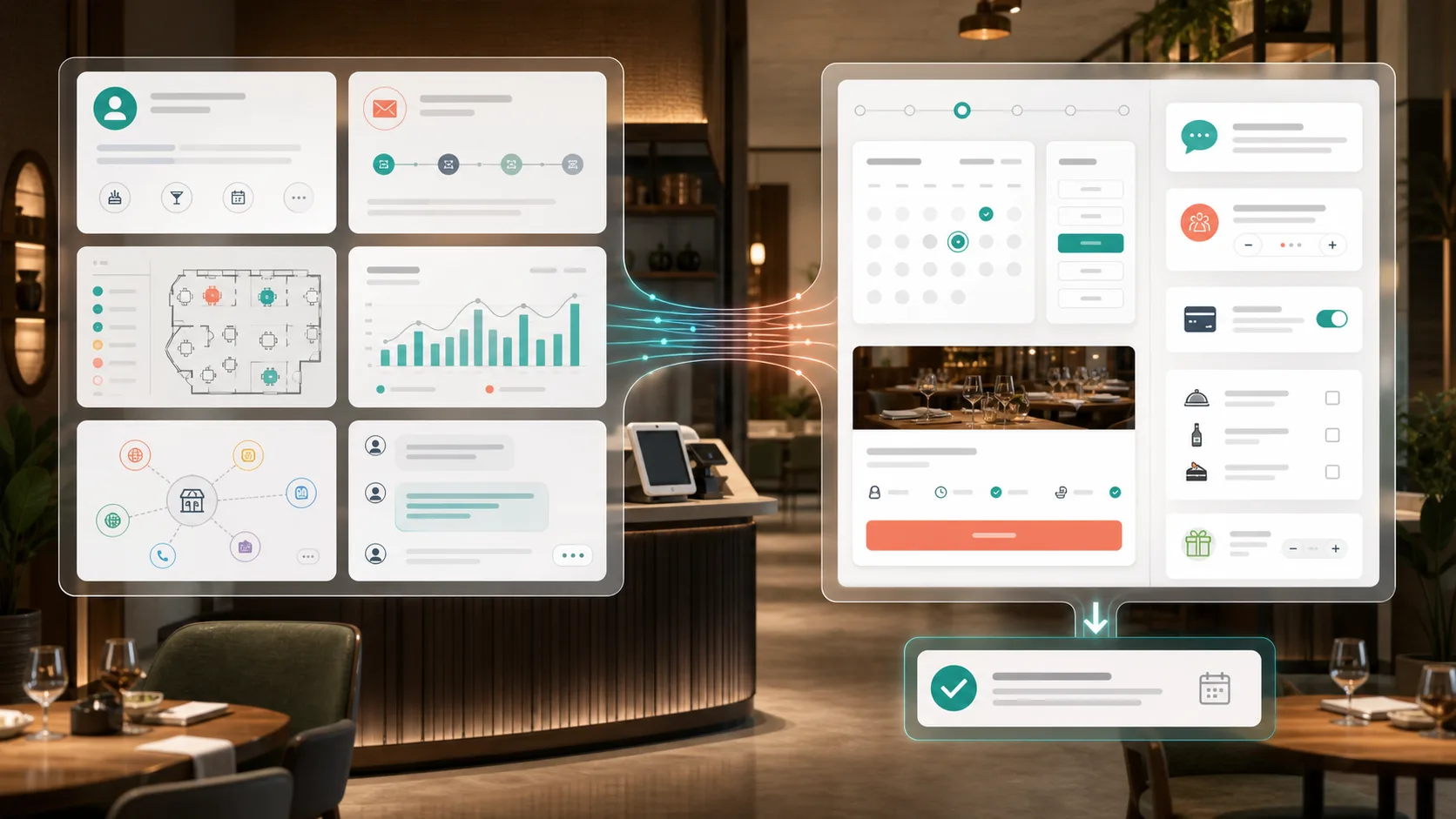
SevenRooms is strongest for restaurant groups that want a broad guest-experience suite with CRM, marketing automation, table management, channel distribution, and add-ons. Reslify is built for teams that want a more focused direct booking platform with branded journeys, AI guidance, flexible payment rules, and no per-booking commission on standard direct reservation intake.
Reslify keeps the core journey centered on branded reservations, payment rules, and guest context.
Guests can get booking help, compare options, and choose add-ons without leaving the direct journey.
Standard direct reservation intake is subscription-based instead of being treated like marketplace demand.
SevenRooms is not a lightweight reservation widget. It is a broad restaurant guest-experience platform. Its public pages position the product around reservations and waitlists, guest profiles, CRM, table management, marketing automation, reputation management, revenue management, add-ons, events, integrations, and marketplace distribution through channels such as DoorDash Reservations and Deliveroo Reservations.
That breadth is useful for some operators. A multi-location hospitality group may want one enterprise suite to manage guest data, marketing segments, table pacing, automated campaigns, event sales, and integrations across properties.
But many restaurants are not trying to buy a large operational suite. They want the public booking journey to be easier to own: branded pages, Google and website conversion, AI-guided guest support, payment commitment, add-ons, gift cards, and staff-visible booking context. They also want standard direct reservations to behave like owned demand, not like marketplace demand.
That is where a SevenRooms alternative becomes worth evaluating. The question is not "can SevenRooms take bookings?" It can. The better question is: do you need the full SevenRooms ecosystem, or a focused direct booking platform built around your own demand?
SevenRooms has a wide product surface. Its official pricing page currently lists Starter, Growth, and Premium packages, with quote-based pricing rather than public monthly dollar amounts. The Starter package includes CRM and guest profiles, branded reservations and waitlist management, access to DoorDash and Deliveroo reservation marketplace users with no cover fees, table management, reputation management, and basic marketing automations. Add-ons include email marketing, event management, Voice AI, WhatsApp and text marketing, API and integrations, and a group portal.
The product pages go deeper. SevenRooms promotes commission-free direct reservations, customizable reservation widgets, online reservations in fourteen languages, Google and social-channel integrations, prepaid upgrades, dining experiences, events, digital payments, POS integrations, guest preferences, credit card holds, deposits, priority alerts, multi-venue booking, virtual waitlists, automated feedback, marketing automation, and AI-assisted table management.
That makes SevenRooms a strong option when the team wants:
SevenRooms is therefore not a bad product to compare against. It is simply a different kind of product. For some restaurants, that breadth is the point. For others, the breadth can create more platform than the team actually needs.
Reslify is built around a narrower, sharper job: help restaurants turn owned demand into confirmed direct bookings without making the booking journey feel generic or fragmented.
That means the public flow matters as much as the back office. A guest may arrive from Google, the restaurant website, Instagram, a QR code, an email campaign, a direct link, or a staff recommendation. If that guest already intends to book the restaurant, the restaurant should be able to convert them in a branded flow that understands availability, areas, party-size rules, cancellation policies, payment requirements, add-ons, gift cards, and language.
| Decision area | SevenRooms-style suite | Reslify direct booking approach |
|---|---|---|
| Product scope | Broad guest-experience platform covering reservations, CRM, marketing automation, table management, revenue tools, waitlists, integrations, and marketplace-connected channels. | Focused direct booking platform for branded reservations, AI-guided booking, payment rules, add-ons, gift cards, Google visibility, and operational context. |
| Best fit | Restaurant groups that want a large hospitality operating suite and are ready to manage the packaging, add-ons, and implementation around it. | Restaurants and groups that want to own the direct booking journey without adopting a heavier enterprise platform. |
| Guest journey | Branded reservation widgets are available, while the broader product also connects to partner and marketplace channels. | White-label booking pages and widgets keep the guest inside a restaurant-owned journey from discovery through confirmation. |
| AI role | SevenRooms highlights AI table management, Voice AI, revenue recommendations, and automation across its platform. | Reslify uses AI inside the booking journey to answer reservation questions, guide choices, and suggest relevant experiences or add-ons while deterministic booking logic confirms the reservation. |
| Direct booking economics | SevenRooms promotes commission-free direct reservations and quote-based packages, with additional modules and add-ons depending on plan. | Reslify uses a flat platform subscription with no per-booking commission on standard direct reservation intake; paid checkout moments such as deposits or gift cards can carry app fees. |
| Strategic goal | Unify guest data, marketing, table operations, and distribution in a larger hospitality platform. | Convert the restaurant's own demand with a branded flow that keeps booking, payment, source, and guest context together. |
This distinction is easy to blur, especially in restaurant reservations.
Marketplace demand is when a guest is undecided. They open a platform, browse a city or cuisine, compare available tables, and choose a venue they may not have searched for directly. In that case, the platform may be creating incremental demand.
Direct demand is different. The guest already knows the restaurant. They search the restaurant by name, tap the Google Business Profile, visit the website, follow the Instagram link, scan a QR code, reply to an email, or return after a previous visit. The restaurant already created that demand through reputation, location, social proof, hospitality, marketing, word of mouth, or repeat loyalty.
For direct-intent bookings, the restaurant should be careful about pushing the guest into a platform-centered journey. Even when a platform does not charge a cover fee for a particular channel, the restaurant may still be training guests to interact through someone else's ecosystem.
This is why "more channels" is not always the same as "better demand." Useful channels should bring new guests or make direct guests easier to convert. They should not make the restaurant's own booking relationship harder to own.
SevenRooms does not currently publish simple public monthly pricing on its pricing page. It presents Starter, Growth, and Premium packages with "Get a quote" calls to action. That page also lists several add-ons, including email marketing, event management, Voice AI, WhatsApp and text marketing, API and integrations, and group portal functionality.
That quote-based structure can be reasonable for larger groups with complex needs. It also means operators should clarify the real package before comparing platforms.
Ask SevenRooms:
Reslify is simpler to reason about because it is positioned as a direct booking platform with published regional subscriptions and no per-booking commission on standard direct reservation intake. In the United States, Reslify is listed at $79/month or $790/year. In Australia, it is A$109/month or A$1,090/year. In Europe, it is €69/month or €690/year. In Turkey, it is TRY 3,490/month or TRY 34,900/year.
The point is not that every restaurant should choose the lowest sticker price. The point is predictability. Restaurants should understand what they are buying, which bookings are monetized, and whether the platform's economics match the way their guests actually book.
Restaurant booking is not a purely administrative moment. It is often the first high-intent interaction before a guest arrives.
For premium venues, chef-driven restaurants, rooftops, tasting menus, private dining, wine bars, brunch concepts, and experience-led groups, the booking flow needs to explain the offer with enough confidence. Is the guest booking the terrace, the bar, the chef's counter, a prepaid menu, a large-party deposit, a birthday setup, a dining credit, or a standard table?
Reslify is designed so these details can live inside a white-label journey:
Brand control is not decoration. It reduces hesitation. It gives guests confidence that they are booking the right experience, under the right policy, with the right expectations.
SevenRooms has a broad AI story. Its public pages highlight Voice AI, AI-powered table management, revenue recommendations, automated marketing, and host-stand optimization. That fits the platform's larger positioning: use automation across operations, guest data, and marketing.
Reslify's AI is intentionally closer to the guest booking moment. The AI booking assistant can help guests understand options, answer reservation-related questions, recommend relevant experiences, and surface add-ons without taking control away from the booking rules.
That last part matters. Restaurant booking is not a free-form chat where anything can be promised. The AI can guide, explain, and suggest. The system still needs deterministic logic for availability, confirmation, capacity, payment, cancellation rules, and staff workflow.
| AI question | What to look for |
|---|---|
| Can AI answer guest questions without inventing policies? | The assistant should be grounded in the restaurant's real booking rules, services, availability, policies, and configured offers. |
| Can it improve conversion? | AI should help guests choose the right time, area, experience, or add-on instead of forcing them to interpret a static form alone. |
| Does it respect operational truth? | Final confirmation, payment, party size rules, and capacity should stay controlled by the booking system. |
| Does staff see the result? | AI-guided choices should appear as useful reservation context, not as disconnected chat history. |
| Does it support the guest's language? | English, German, and Turkish support matters when the restaurant serves mixed local and travel demand. |
AI is valuable when it removes friction. It becomes risky when it makes the booking system less precise. Reslify's approach is to keep AI helpful and the reservation logic explicit.
One reason restaurants outgrow simple reservation tools is that not every booking carries the same risk or revenue opportunity.
A table for two on a quiet Tuesday may not need payment commitment. A chef's counter, private room, holiday service, terrace table, large party, tasting menu, or high-demand night may need a deposit, card hold, prepayment, cancellation fee, or paid add-on.
SevenRooms supports many revenue tools across its broader platform. Reslify's angle is to put those moments directly inside the branded booking flow so the restaurant can protect revenue without creating separate guest journeys.
| Revenue moment | How Reslify keeps it connected |
|---|---|
| Deposits | Require partial commitment for high-risk bookings, larger parties, special services, or premium inventory. |
| Prepaid experiences | Sell tasting menus, events, chef's counters, brunch packages, or limited inventory before service. |
| Optional prepayment | Let guests choose a pay-now path where it improves commitment without making every booking feel heavy. |
| Card holds | Protect against no-shows and late cancellations without charging guests upfront by default. |
| Add-ons | Offer champagne, cakes, flowers, premium seating, celebration packages, dining credits, or other configured enhancements during booking. |
| Gift cards | Sell and redeem prepaid value while keeping the booking, payment, and guest record connected. |
This matters because fragmentation is expensive. If the reservation sits in one system, the gift card in another, the deposit somewhere else, and the guest notes in a separate CRM, staff have to reconstruct the truth manually. A direct booking journey should reduce that work.
SevenRooms is known for guest data and CRM depth. Restaurants comparing alternatives should acknowledge that strength. If the business needs a mature hospitality CRM with marketing automation, segments, campaign analytics, POS-driven guest history, and multi-property guest profiles, SevenRooms deserves serious consideration.
Reslify's data argument is different. It is about keeping the direct booking relationship clean from the first touch. The restaurant should know where the guest came from, what they booked, which rules applied, what they paid or committed to, which add-ons or gift cards were involved, and what staff need to know before service.
That context should be useful at the host stand and in operations:
The goal is not data collection for its own sake. The goal is a better booking, a clearer service handoff, and a stronger direct relationship after the guest confirms.
Choose SevenRooms if the restaurant wants a broad guest-experience platform and expects to use the breadth: CRM, guest profiles, marketing automation, table management, waitlists, reputation tools, event management, partner channels, API access, and enterprise workflows.
Choose Reslify if the restaurant wants a focused direct booking platform that keeps the public journey branded, uses AI to guide guests inside the reservation flow, supports payment commitment and revenue moments, and keeps standard direct reservation intake free from per-booking commission.
| Restaurant priority | Better fit |
|---|---|
| We want a broad hospitality suite with CRM, marketing automation, table operations, and revenue tooling. | SevenRooms |
| We want a focused direct booking platform without adopting a heavier enterprise suite. | Reslify |
| We want DoorDash and Deliveroo reservation marketplace access as part of the platform strategy. | SevenRooms |
| Most guests already search for us directly or arrive from Google, our website, Instagram, repeat visits, or word of mouth. | Reslify |
| We need deep marketing segmentation, campaign automation, and POS-connected CRM workflows. | SevenRooms |
| We need branded booking pages, Reserve with Google, AI booking guidance, deposits, add-ons, gift cards, and direct booking ownership. | Reslify |
| We are comfortable with quote-based packaging and add-on evaluation. | SevenRooms |
| We want published subscription pricing and no per-booking commission on standard direct reservation intake. | Reslify |
The decision is less about whether one platform has more features. More features only help when the restaurant will actually use them. For many teams, the better system is the one that protects the direct guest relationship and makes the most important booking workflows easier to manage.
Before replacing SevenRooms, or choosing an alternative before rollout, map the operational consequences. Reservation systems touch the website, Google, social channels, staff habits, payment policies, guest data, reporting, marketing, and service.
The cleanest migration starts with a simple inventory: what the restaurant really needs to sell, protect, and operate reservations directly.
Not exactly. SevenRooms is primarily a guest-experience and restaurant operations platform with reservations, CRM, table management, marketing automation, and revenue tools. It also promotes partner and marketplace distribution, including DoorDash Reservations and Deliveroo Reservations. Restaurants should evaluate both parts: the operations suite and the channel ecosystem.
Reslify makes sense when the restaurant wants a focused direct booking platform rather than a broader enterprise suite. The strongest fit is a venue or group that cares about branded booking pages, owned guest context, Reserve with Google, AI-guided booking, payment rules, add-ons, gift cards, and predictable standard direct booking economics.
SevenRooms currently presents Starter, Growth, and Premium packages on its pricing page with "Get a quote" calls to action. It also lists several add-ons. Restaurants should confirm package requirements, add-on costs, onboarding costs, integration costs, and commercial treatment by booking source before comparing total cost.
Reslify does not charge per-booking commission on standard direct reservation intake. Paid checkout moments, such as deposits, prepayments, gift cards, and other app-mediated transactions, can include app fees because money is moving through the platform.
Yes. Reslify supports Reserve with Google so guests can book from Google while the restaurant keeps availability, booking rules, payment policies, and operational context connected to the same direct booking system.
Reslify supports English, German, and Turkish. That is important for restaurants serving local guests, international visitors, and multilingual staff workflows.
No platform is the right replacement for every restaurant. If the team depends heavily on SevenRooms' full CRM, marketing automation, table management, waitlist, API, and enterprise workflows, SevenRooms may remain the better fit. Reslify is the stronger alternative when the goal is direct booking ownership, branded conversion, AI booking guidance, and connected payment/revenue moments.
This comparison uses publicly available SevenRooms pages, including the SevenRooms homepage, pricing, reservations and waitlist, marketing automation, table management, and revenue management pages, checked on July 2, 2026.
Compare Quandoo alternatives for restaurants that need to replace online reservations before Quandoo stops new bookings on 30 September 2026.
Read moreComparisonA practical OpenTable alternative comparison for restaurants that want direct bookings, owned guest data, branded booking pages, and flexible payment rules.
Read moreComparisonCompare restaurant reservation systems for direct bookings, marketplace reach, guest data, payments, Google visibility, and branded booking control.
Read more