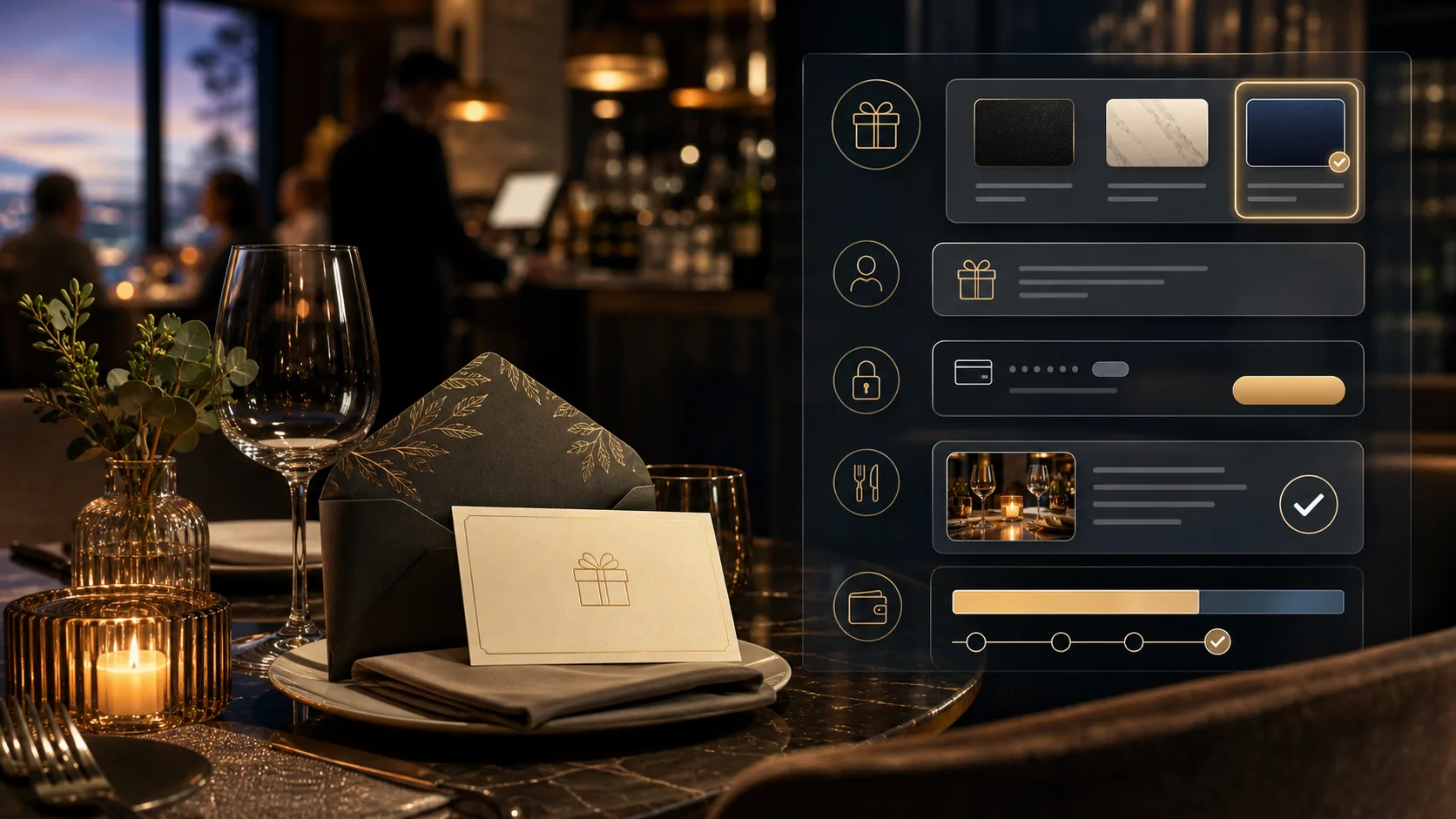
Gift cards should become part of the booking journey
Restaurant gift cards can be more than a checkout link on a website. Done well, they create prepaid demand, help guests buy a future visit with confidence, and bring revenue into the restaurant before the table is booked.
The problem is that many gift card programs sit outside the reservation workflow. A guest buys a card in one tool, receives a code in another, books a table somewhere else, and redeems value through a manual staff process. That may work for a small volume of cards, but it becomes messy when gift cards, guest notes, payment rules, add-ons, and reservation details all live in separate places.
A better restaurant gift card strategy connects sale, delivery, redemption, and booking context. The gift card can still feel elegant to the buyer and recipient, but operations stay clear for the team.
Key takeaways
- Restaurant gift cards work best when they are connected to reservations, checkout, and guest records.
- Gift card products should be packaged around dining intent: value, occasion, experience, or hosted group use.
- The redemption flow should quote applied value, payment remainder, and remaining balance before the booking is submitted.
- Staff should see the gift-card context alongside the reservation, not in a separate spreadsheet or payment tool.
- A multilingual, branded gift-card flow helps restaurants sell to local guests, tourists, and corporate buyers without weakening the venue experience.
Why fragmented gift cards create operational drag
Gift cards usually start as a revenue idea and become an operations problem.
A separate gift-card provider can sell the card, but it often does not know which experience the guest books, which add-ons were selected, whether the booking requires prepayment, or whether the card was attached to a reservation that later changed. Staff then have to reconcile codes, balances, payment remainders, and guest expectations by hand.
That fragmentation creates avoidable questions:
- Was this code already used for another reservation?
- How much value should apply to this booking?
- Does the remaining amount need to be paid online or on site?
- Was the card attached to a reservation that was cancelled or never completed?
- Can front-of-house see that the guest is arriving with gifted value?
- Does the guest understand the remaining balance after this booking?
The risk is not only accounting. It affects service. If the team cannot see the card context before the visit, a prepaid gift can turn into an awkward moment at the table.
The stronger model: sell, issue, redeem, and track in one flow
A connected gift-card program has four parts.
- The restaurant creates clear gift-card products.
- The buyer purchases through a branded checkout flow.
- The recipient receives the issued card and code.
- The guest applies the code inside the reservation journey before submitting the booking.
Reslify supports this model by keeping gift-card sales and reservation redemption close to the booking system. Restaurants can define gift-card products with a title, description, amount, currency, validity period, and image. Guests can buy for themselves or send to someone else, add a personal message, and continue through secure checkout. When the card is issued, it can be redeemed during the booking journey with quote logic that shows applied amount, payment remainder, and remaining balance.
That is the important shift: gift cards stop being detached payment artifacts and become part of the guest experience.
| Gift-card moment | Fragmented approach | Connected booking approach |
|---|---|---|
| Product setup | Generic value cards in a separate checkout tool | Branded gift-card products with amount, currency, validity, image, and venue context |
| Purchase | Buyer leaves the restaurant journey for a third-party page | Buyer chooses a card, recipient mode, message, and checkout from the venue's branded surface |
| Delivery | Card details live away from guest and booking records | Issued card, code, purchaser, recipient, and message stay tied to the merchant |
| Redemption | Staff manually check code and balance | Guest applies a code before booking submission and sees applied value, remainder, and balance |
| Operations | Reservation, payment, and gift-card state must be reconciled later | Gift-card attachment, release, consumption, and reservation summary are tracked together |
Package gift cards around why people buy them
Restaurants should not think of gift cards only as "$100 credit." People buy restaurant gift cards because they want to give someone a future moment.
That moment may be simple: dinner for two, a birthday, a thank-you gift, a date night, a graduation, or a work celebration. It may be more premium: a tasting menu, chef's counter, rooftop evening, champagne add-on, private-room deposit, or seasonal dining experience.
The product catalog should make those choices easy.
- Offer simple value cards for buyers who already know the recipient will choose their own visit.
- Create occasion-led cards for birthdays, anniversaries, thank-you gifts, and celebrations.
- Connect premium cards to dining experiences, prepaid menus, or event-style reservations.
- Use images that match the venue's brand instead of generic gift-card artwork.
- Set validity periods clearly so guests know when the value should be used.
- Write descriptions that explain the dining moment, not just the monetary amount.
The language matters. "Dinner gift card" is functional. "A chef's counter evening for two" gives the buyer a clearer reason to purchase.
Make checkout feel like the restaurant
Gift cards are often bought by guests who are not booking immediately. They may come from search, social, the restaurant website, a hotel recommendation, or a corporate gifting request. The flow still needs to feel like the venue.
A strong restaurant gift-card checkout should let the buyer:
- Choose from visible card products with clear value and descriptions.
- Buy for themselves or send directly to a recipient.
- Enter purchaser and recipient details without unnecessary friction.
- Add a personal message when the gift is for someone else.
- Complete secure checkout through the supported payment provider.
- Receive a clear issued-card state after payment is confirmed.
In Reslify, the public gift-card surface supports product selection, buyer and recipient modes, personal messages, Stripe redirect checkout, PayTR iframe checkout where applicable, and issued-card status after payment confirmation. The point is not to make gift cards feel like a separate ecommerce store. The point is to make them feel like a bookable part of the restaurant's guest journey.
Bring redemption into the reservation flow
Redemption is where many gift-card systems fall apart.
If the guest has to call, email, mention a code in a free-text note, or present a screenshot after the meal, the restaurant loses control of the payment expectation. A connected flow should validate the gift card before the booking is submitted, while the reservation still knows the selected time, experience, covers, add-ons, and payment selection.
That allows the booking journey to answer practical questions:
- Is this card valid for this merchant?
- Is the card expired, depleted, or already attached to another reservation?
- How much value applies to this specific booking?
- What payment amount remains after the card is applied?
- What balance will remain on the card after this booking?
- Should the card be attached, released, or consumed as the reservation lifecycle changes?
This is the difference between a gift card as a code and a gift card as operational context.
Keep the team aware before service
Gift-card redemption should not surprise the host team at the end of the meal. If the booking involves a prepaid experience, add-ons, a deposit, or a card balance, staff should have the relevant payment context before the guest arrives.
That context helps with:
- Confirming whether value was applied to the reservation.
- Understanding the remainder that still needs payment.
- Seeing whether the gift card has remaining balance after the booking.
- Preparing for occasion-led gifts with personal messages or celebration intent.
- Avoiding manual balance checks during service.
- Reducing disputes when a card was attached to a reservation but later cancelled or changed.
For restaurants and groups, this is where gift cards become part of revenue control. The sale happens before the visit, but the value is still connected to the service moment.
Use gift cards across the guest lifecycle
Gift cards are usually marketed during holidays, but restaurants can use them all year if the program connects to actual booking behavior.
Here are practical campaign angles:
| Campaign | What to sell | Why it works |
|---|---|---|
| Occasion gifting | Birthday, anniversary, graduation, thank-you, or celebration cards | The buyer has a clear reason and the recipient arrives with context. |
| Experience gifting | Tasting menus, chef's tables, brunch packages, or rooftop evenings | Premium cards feel more memorable than generic value. |
| Corporate hosting | Dining credits for teams, clients, and partners | Businesses can buy hospitality value without choosing the reservation date yet. |
| Local loyalty | Cards for regular guests who want to prepay future visits | The restaurant captures cash before the booking and keeps demand direct. |
| Cancellation recovery | Venue credit for eligible paid booking outcomes | Value can stay with the restaurant while giving the guest a usable path back. |
Do not overcomplicate the catalog. A few well-named products are usually stronger than a long menu of nearly identical amounts.
Multilingual and multi-market details matter
Gift cards often cross language boundaries. A local guest may buy a card for a visiting friend. A tourist may buy before a trip. A corporate buyer may purchase from another country. The gift-card flow needs to be understandable in the language and currency context the guest expects.
Reslify product surfaces support English, German, and Turkish with locale-aware date, time, and currency formatting across the guest booking experience and merchant dashboard. For gift cards, that means the strategy should account for product wording, validity dates, checkout clarity, recipient communication, and redemption expectations in the languages your guests actually use.
The operational data underneath should stay consistent even when the guest-facing language changes. A code, amount, remaining balance, reservation attachment, and payment remainder should mean the same thing in every locale.
A practical checklist for restaurant operators
Before launching or rebuilding a restaurant gift-card program, answer these questions:
- Can guests buy gift cards from a branded public page?
- Can each card product have a clear amount, currency, validity period, description, and image?
- Can buyers send cards to themselves or directly to someone else?
- Can recipients receive a usable code after payment confirmation?
- Can guests apply a gift card while booking, before they submit the reservation?
- Can the booking flow show applied amount, payment remainder, and remaining balance?
- Can the restaurant prevent double-use while a card is attached to a reservation?
- Can staff see gift-card context alongside reservation and payment context?
- Can the card be released or consumed correctly as the reservation lifecycle changes?
If the answer is no to several of these, the gift-card program may still sell value, but it will create work later.
Where Reslify fits
Reslify is built for restaurants that want direct booking, branded guest journeys, payment commitment, and revenue moments in one system. Gift cards fit naturally into that model because they connect prepaid value with the future reservation.
The strongest gift-card strategy is not "add a gift card button." It is: sell a polished dining product, issue it cleanly, let the guest redeem it during booking, and keep the value visible to the team that will serve the table.
That gives restaurants a better revenue tool and gives guests a smoother path from gift to visit.
FAQ
Are restaurant gift cards only useful during holidays?
No. Holidays are useful, but restaurants can sell gift cards around birthdays, anniversaries, thank-you moments, corporate hosting, local loyalty, premium experiences, and dining credits throughout the year.
Should restaurants sell value cards or experience cards?
Most restaurants should offer both. Value cards are flexible and easy to understand. Experience-led cards feel more premium because they connect the gift to a specific kind of visit, such as a tasting menu, chef's counter, brunch, or celebration package.
Why should gift-card redemption happen inside the booking flow?
Because the booking flow knows the selected date, time, covers, experience, add-ons, and payment requirement. That makes it possible to quote the applied amount, remainder, and remaining balance before the guest submits the booking.
What causes gift-card fragmentation?
Fragmentation happens when gift-card sales, issued codes, reservation details, payment rules, guest records, and staff workflows sit in different systems. The result is manual reconciliation and a weaker guest experience.
Can gift cards support prepaid restaurant experiences?
Yes, when the gift-card program is connected to the booking and payment journey. The guest can buy or receive prepaid value, then apply it toward a reservation that may include experiences, add-ons, deposits, or other payment rules.