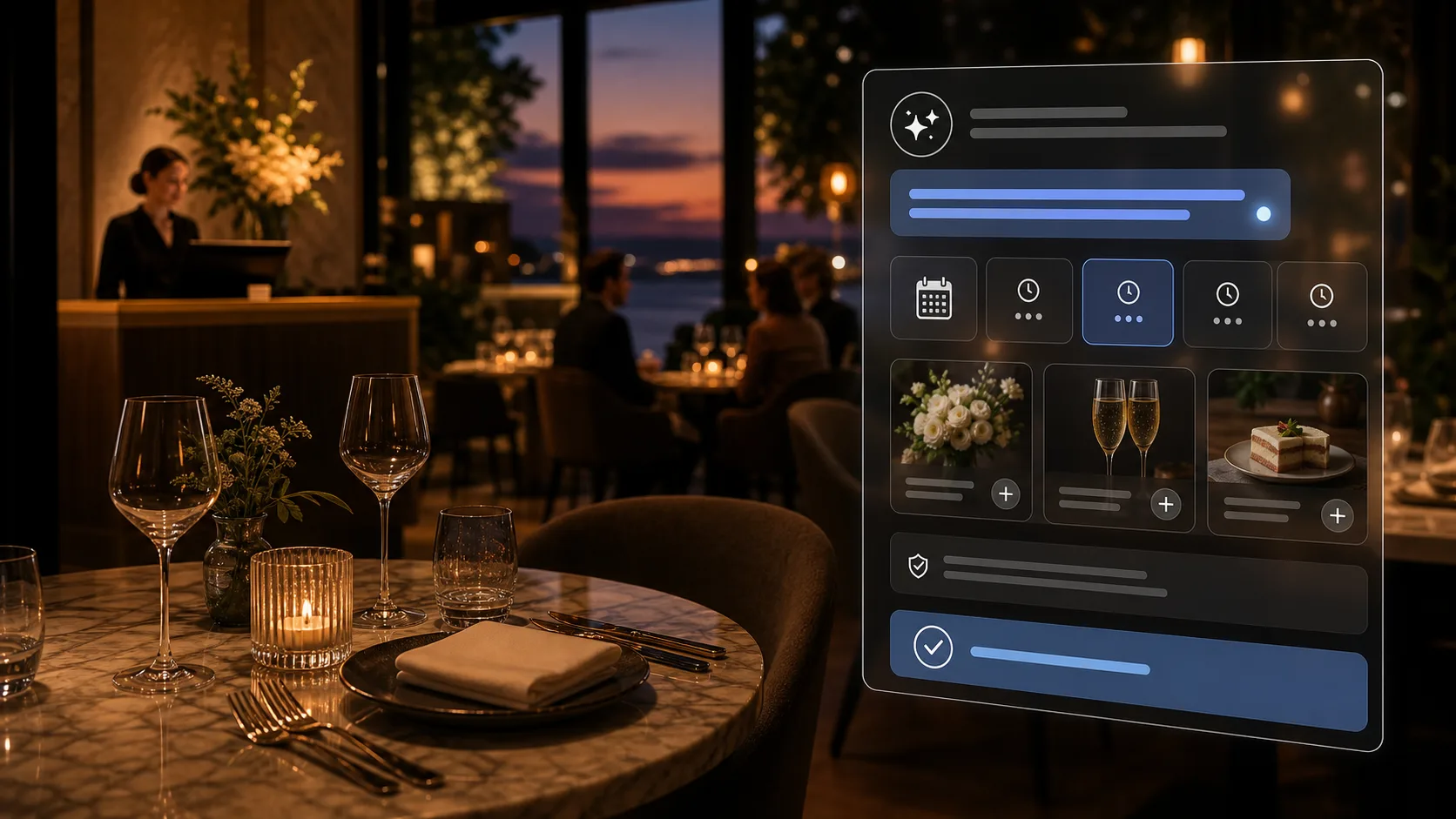
What an AI restaurant booking agent should actually do
An AI restaurant booking agent should help a guest make a better reservation without taking control away from the restaurant's booking system.
That sounds simple, but it is the difference between a useful booking concierge and a risky chatbot. A strong AI restaurant booking assistant can answer booking-related venue questions, clarify what the guest wants, suggest relevant experiences or add-ons, and help recover a search when the first option is unavailable. The actual reservation, availability check, slot hold, payment rule, policy acceptance, and final confirmation should still run through the canonical booking journey.
In other words: the assistant guides the guest. The booking flow remains the source of truth.
Key takeaways
- The best AI booking agents sit inside the reservation journey, not beside it.
- Availability, holds, payments, policies, and confirmation should stay deterministic.
- The agent should answer from merchant-provided context and configured booking data.
- Commercial suggestions work when they are relevant: experiences, add-ons, premium seating, deposits, and celebration packages.
- Multilingual support matters because guests book in the language they are most comfortable using.
Why restaurants are looking at AI booking agents
Restaurant bookings rarely fail because the guest dislikes filling out a form. They fail because the guest is unsure.
They want to know whether a tasting menu is right for an anniversary, whether a terrace table is bookable, why a deposit is required for larger parties, whether children are welcome at a certain sitting, or what to do when 8:00 PM is unavailable. If that information is buried on the website, answered manually by staff, or missing from the booking path, guests hesitate.
An AI booking assistant is valuable when it shortens that hesitation. It can turn a vague intent like "I need somewhere special for four on Friday" into a more complete booking path: party size, date, time, area preference, experience choice, add-ons, notes, policies, and payment expectations.
The business case is not "AI for the sake of AI." It is better conversion, fewer repetitive questions, more relevant revenue moments, and clearer operational context before service.
The safe architecture: AI around the journey, not instead of it
A restaurant booking agent should not become a second booking system. If the agent invents availability, silently changes a reservation, accepts payment outside the normal flow, or confirms something the host team cannot see, it creates operational risk.
The safer model has three layers:
- The booking journey owns the transaction.
- The AI assistant interprets guest intent and proposes help.
- The guest explicitly approves consequential actions.
Reslify follows this model. The Booking Copilot is embedded in the New Booking Journey for one merchant. It can answer grounded booking-adjacent questions, apply low-risk draft updates, suggest relevant configured offerings, and propose pending actions. It does not own availability, holds, guest details, payments, policies, or final confirmation.
| Booking moment | What AI can help with | What should stay deterministic |
|---|---|---|
| Choosing a time | Interpret intent, suggest nearby alternatives, recover no-availability searches | Live availability, slot eligibility, and hold creation |
| Choosing an experience | Explain configured experiences and recommend a fit | Experience selection that affects price, rules, capacity, or checkout |
| Adding extras | Suggest relevant add-ons such as champagne, flowers, cakes, or premium seating | Addon quantity, compatibility, pricing, and confirmation |
| Guest details | Recognize details the guest voluntarily provides and ask for approval to apply them | Name, email, phone, and final guest record |
| Payments and policies | Explain visible deposit, prepayment, card-hold, or cancellation rules | Policy acceptance, checkout, payment links, and authorization |
What the agent needs to know
Generic chat is not enough for restaurant reservations. A booking agent needs access to the facts that determine what the guest can actually book.
For Reslify, that context can include:
- Merchant public booking context, such as parking notes, dress guidance, accessibility information, celebration policies, or other public visit-planning details.
- Merchant profile information, including venue name, address, public contact details, and website.
- Configured experiences, such as tasting menus, chef's tables, events, brunch sittings, or premium booking paths.
- Configured add-ons, such as champagne, cakes, flowers, tasting upgrades, dining credits, or celebration packages.
- Configured areas, such as terrace, bar, lounge, dining room, counter, rooftop, or private room.
- Visible booking journey state, including party size, selected date, selected time, current step, visible slots, operating schedule, selected experience, and selected add-ons.
That last point matters. The assistant should answer from what the booking journey can see. If it does not know a fact, it should say so and give the guest a practical next step. It should not infer restaurant facts from the venue name, location, or vibe.
High-value use cases for an AI booking assistant
1. Recovering searches with no availability
No availability is one of the most important moments in the booking journey. A basic form says "nothing available" and leaves the guest to start over. A better assistant helps the guest keep moving.
For example, if a guest searches for four people at 8:00 PM and no slot is available, the assistant can summarize the failed search, use visible suggested dates, consider open dayparts from the operating schedule, and propose concrete next checks such as 7:30 PM, 8:30 PM, a different area, a different experience, or another nearby date.
The agent should not promise availability. It should guide the guest toward real options the booking flow can verify.
2. Helping guests choose the right experience
Restaurants increasingly sell more than standard tables: tasting menus, prepaid events, chef's counters, rooftop packages, brunch services, and seasonal dining moments. The problem is that guests do not always know which option fits their occasion.
An AI booking agent can ask lightweight clarifying questions and explain configured experiences in plain language. If a guest says, "It is my partner's birthday and we want something special," the assistant can recommend a configured birthday-friendly experience if one exists. If nothing relevant is configured, it should not invent one.
3. Suggesting relevant add-ons and upgrades
Upsells work best when they feel like service, not interruption. Champagne for an anniversary, flowers for a romantic dinner, a cake for a birthday, premium seating for a celebration, or a dining credit for a hosted event can improve the visit and increase booking value.
The key word is relevant. A strong AI restaurant booking assistant should only suggest configured offerings that fit the guest's stated intent or the current journey. It should not spray every add-on at every guest.
4. Capturing useful notes before confirmation
Guests often mention context naturally: "We are celebrating a graduation," "one person uses a wheelchair," "we would prefer a quieter table," or "please avoid the bar area." The assistant can help turn that into visible booking notes.
Those notes should not become hidden agent memory. They should be shown back to the guest before confirmation and then land in the operational workflow where the front-of-house team can see them.
5. Explaining deposits, prepayments, and card holds
Payment commitment is sensitive. Restaurants need no-show protection, especially for larger parties, prepaid menus, high-demand nights, and special events. Guests need clarity.
An AI assistant can explain why a deposit, prepayment, optional prepayment, or card hold appears in the booking flow. But it should not accept a policy or move the guest into checkout without explicit approval. Payment and policy actions should remain visible, auditable, and tied to the booking flow.
What restaurants should avoid
The fastest way to make AI feel powerful is to let it do too much. The fastest way to make it operationally dangerous is the same.
Avoid an AI booking agent that:
- Confirms reservations in chat without showing the deterministic booking summary.
- Claims a slot is held when the booking system has not created a real hold.
- Accepts guest details, payment choices, or policy acceptance without explicit approval.
- Answers venue questions from guesswork instead of merchant-provided public context.
- Suggests add-ons that are not configured, not compatible with the selected experience, or unrelated to the guest's intent.
- Creates a parallel booking path that staff cannot audit from the normal reservation workflow.
AI should reduce friction. It should not create invisible commitments.
How multilingual booking should work
Restaurant demand is often international. A guest may discover a venue through Google, Instagram, a hotel recommendation, or a concierge link, then book in a language that is not the venue team's default.
That means an AI booking assistant should respect the booking journey's language preference and keep the guest in a familiar flow. Reslify product surfaces support English, German, and Turkish, with locale-aware date, time, and currency formatting across the guest booking experience and merchant dashboard.
For the AI layer, the same principle applies: respond in the guest's preferred booking language unless the guest asks to switch, keep structured booking actions language-independent underneath, and make sure staff still receive clear reservation details in the operational workflow.
This is especially important for:
- Tourist-heavy restaurants where guests book before arriving in the city.
- Hospitality groups operating across countries or serving multilingual neighborhoods.
- Premium venues where policy, deposit, or experience details must be understood before payment.
- Turkish, German, and English-speaking guests who need the same booking logic with localized wording.
How to evaluate an AI restaurant booking agent
If you are choosing an AI booking assistant for your restaurant, use practical questions instead of demo magic.
| Question | Why it matters |
|---|---|
| Does the agent sit inside the booking journey? | It should improve conversion without creating a second source of truth. |
| Does it use live booking state? | Recommendations should reflect visible availability, selected date, party size, selected experience, and current step. |
| Can the restaurant control its public context? | Answers should come from merchant-provided facts, not generic assumptions. |
| Are experiences and add-ons configured in the platform? | Revenue suggestions should map to real bookable items. |
| Do consequential actions require guest approval? | Holds, guest details, add-ons, policies, payments, and final confirmation need explicit consent. |
| Does the team see the result operationally? | Notes, preferences, selected enhancements, and payment state should land where staff work. |
| Does it support the languages your guests use? | AI guidance is only useful when the guest understands the booking path. |
Where Reslify fits
Reslify is built for restaurants that want direct, branded booking journeys instead of fragmented booking links and marketplace-led workflows. The AI-guided booking experience is part of that broader system.
The assistant can help a guest decide and move through the journey, while Reslify keeps the core booking mechanics grounded in the platform: live availability, service rules, experiences, add-ons, deposits, prepayments, card holds, guest records, Google visibility, and staff-facing operations.
For a restaurant, the goal is not to replace the host team with chat. The goal is to make every public booking surface more helpful before the guest reaches out manually, then give staff better context when the booking lands.
FAQ
Can an AI restaurant booking agent book a table by itself?
It should not silently book a table by itself. A safer agent can prepare draft changes, propose slot holds, suggest configured experiences or add-ons, and guide the guest to confirmation. The guest should still explicitly approve consequential actions and confirm the final booking in the normal reservation flow.
Should the agent answer every guest question?
No. It should answer booking-related venue questions when the answer is available from merchant-provided public context, configured offerings, visible availability, operating schedule, or current booking state. If the answer is not known, it should say so and redirect the guest to a practical next step.
Can AI help restaurants increase booking value?
Yes, when suggestions are relevant and configured. The best opportunities are prepaid experiences, premium seating, celebration add-ons, dining credits, gift cards, deposits, optional prepayment, and card holds for bookings that need revenue protection.
How does this help the front-of-house team?
It reduces repetitive pre-booking questions and can capture useful guest intent before confirmation. The important part is that selected experiences, add-ons, notes, policies, and payment status must flow into the normal operational workflow, not stay inside a chat transcript.
Is an AI booking assistant useful for small restaurants?
It can be, especially if the restaurant receives repetitive questions, sells experiences or add-ons, needs deposits for certain bookings, or serves guests in multiple languages. Restaurants that only need a very simple free booking form may not need AI guidance yet.